Political Philosophy
The war between U.S. Catholic bishops and the Obama administration over Obamacare's abortion, sterilization and contraceptive mandate has been well publicized and was to be expected. Democrats, including Catholic Democrats, have openly and notoriously held policy positions with regard to these sexual issues which run directly counter to Catholic social teaching. That the bishops believed Obama would exempt religious institutions from submission to such regulations exposed profound naivety, but the ideological tension and potential for conflict was apparent to all.
The bishops' recent stance against Rep. Paul Ryan's budget in the House likely took many by surprise. The Church would seem to a casual observer to fit hand in glove with the Republican Party platform - primarily because the media usually only highlights the Church's position on a single issue: abortion. But those more intimately aware of the Church's hierarchy will notice a plethora of self-identifying blue-collar, union-supporting Democrats among the nation's Catholic leaders. These are Joe Biden, Nancy Pelosi and John Kerry Catholics, absent the pro-choice stain. The social gospel, according to this large faction, fits squarely with liberal economic policies. And so, we have the present impasse over the Ryan budget.
And it's a wonderful thing.
The debate will largely be decided by the November elections and the weight of the mandate handed to the victorious party. Nevertheless, for the first time in recent history, America is witnessing a mature and principled political debate. Between the GOP and the Catholic Church, no mud is being thrown, no names are being called and both sides are showing respect to the ideas and persons of their rivals. Gently rebuking the Georgetown Ninety, Ryan reiterated that the financial crisis requires a "charitable conversation." This is the model of political bipartisanship which America demands and deserves.
Unfortunately, it only exists because one party decided to sit this one out.
Economy
It may be no accident that most of the states in the top 20 are also right-to-work states, as labor force flexibility is highly sought after when a business seeks a location. Several economists, most notably Ohio State's Richard Vedder and Harvard's Robert Barro, have found that the economies in R-to-W areas grow faster than other states, have higher employment and attract more inward migration. Governor Scott Walker's battle with the unions in Wisconsin (See "Will Wisconsin Rise Again?"), a state that edged into the top 20 this year for this first time, demonstrates that the struggle for a pro-growth agenda can be contentious. As one Badger State business leader remarked, "Finally, Wisconsin is headed in the right direction."
The Lone Star State was given high marks foremost for its business-friendly tax and regulatory environment. But its workforce quality, second only to Utah's, is also highly regarded.
Conservatives couldn't make up such favorable talking points.California's enduring place of perpetual decline continues in this year's ranking. Once the most attractive business environment, the Golden State appears to slip deeper into the ninth circle of business hell. The economy, which used to outperform the rest of the country, now substantially underperforms. And its status as the most ruinously contentious place to operate remains undisturbed in eight years. Its unemployment rate, at 10.9 percent, is higher than every other state except Nevada and Rhode Island. With 12 percent of America's population, California has one-third of the nation's welfare recipients. Each year, the evidence that businesses are leaving California or avoid locating there because of the high cost of doing business due to excessive state taxes and stringent regulations, grows. (See "Eastward Ho!") According to Spectrum Locations Consultants, 254 California companies moved some or all of their work and jobs out of state in 2011, an increase of 26 percent over the previous year and five times as many as in 2009.The following is a representative sample of comments from participating CEOs:
- California is the worst! They are doing everything possible to drive a business out of their state. If it were not for the climate, they would have lost half their population
- California regulations, taxes and costs will leave only tech, life sciences and entertainment as viable. If you aren't an elitist, no room here for the middle or working classes.
- California treats business owners like criminals. California has different overtime policies for its own employees vs. private sector.
- California's labor regulation is a job killer. We will be moving our business out of the state, which will lose hundreds of jobs simply due to the poor regulatory environment.
- California should secede from the union--it is like doing business in a foreign country, it has its own exchange rate, and its regulation is crazy.
Economy
AEI's on-line magazine, The American, posits that "Middle America is a clear picture of how much the basics matter: Cost of living, job quality, schools, and opportunities to develop the right skills for the best jobs."
The Midwest's story is important because it serves in significant ways as a regional microcosm of how growth and opportunity should look in America today.
In a recent study we look at trends that upend the conventional wisdom about the Midwest. We find that it is neither doomed to a slow and dirty demise like an old house on an eroding slope, nor forced to reinvent itself Dubai-style in order to compete with Silicon Valley or Manhattan. The Midwest's future is rooted very much in its past--but with some important updates.
What do we mean? For starters, this means capitalizing on Americans' desire to reside where the cost of living and doing business is favorable. As the last Census showed, Americans move in droves to regions where the cost of living is low, businesses face fewer obstacles, and workers have choices. As Wendell Cox and Joel Kotkin have shown, this goes for 25- to 35-year-olds as well as 55- to 65-year-olds. People want options and a good quality of life at a price they can afford.
In the Midwest, these trends have favored placed like Columbus, Ohio . . . .
Noting that 83% of manufacturers nationwide complain of "a moderate or severe shortage of skilled production workers," the authors suggest that the Midwest is on the verge of a "new industrial paradigm," which will be "characterized by a blend of heavy manufacturing, new technology, a more highly educated industrial labor base, and lighter labor restrictions." That last factor is a reference to labor law reforms such as the recent movement to quell labor unions and establish "right-to-work" states.
When you add to all of this the new energy sources discovered in some parts of the Midwest--such as new finds in Utica shale in Ohio--a new industrial paradigm in the region could end up being a large source of new wealth creation in the coming generation.
Let us hope that Ohio may provide the model by which to lead America from economic malaise. But to do so, those who are opposed to labor reform and who wish to suppress natural gas production will have to be defeated. Unions and environmentalists - that is, Democrats - continue to prioritize self-interest and disfavored ideologies above economic recovery. One hopes that these factors will influence voters in Ohio, the Midwest and throughout America in November.
Economy
National Review has an editorial up on President Obama's "Buffett tax" gambit. As they note it won't generate much income for the government, and most people with $1 million or more in income already pay a roughly 30% tax rate.
If the President really wants to tax Buffett, and if Buffett really thinks he's undertaxed, there's a much better way to go. Mr. Buffett claims roughly $40 million in income. He has a net worth of roughly $50 billion. That means his return on investment is less than 1%, for officially purposes at least. Why so low? Buffett pays no dividend in his holding company, and does not take the kind of salary that most people who run large companies take.
If we really want to raise taxes on Mr. Buffett, we should pay attention to the reason why his income is so low. Mr. Buffett's refusal to pay a dividend deprives we the people of a greater share of his true income. And if the failure to buy an item can be taxable--the argument that he supporters of Obamacare make--surely it is also reasonable to force Buffett to pay an "idle capital" penalty. So long as he conspires against the people, and deprives us of tax revenue, by refusing to pay a dividend, he should pay a penalty.
Economy
Alberto Mingardi directs the Italian free-market think tank [yes, there are a few] Istituto Bruno Leoni. In the WSJ, he channels Friedrich Hayek to critique of the European Union.
Centralized welfare systems are necessarily run by a bureaucratic leadership that cannot master the knowledge needed to manage a complex society.
As Mingardi notes, "Hayek is often associated with his critique of socialist systems."
There is, in society, a "knowledge problem": Economic life requires the coordination of individual planning. The relevant knowledge for economic planning is dispersed rather than concentrated in society. If this makes coordination challenging enough in a market system, it also makes coordination a virtual impossibility under central planning: The planner can never secure and process all the necessary information to provide detailed guidance to any given development in society.
Mingardi applies Hayek's critique to "hard-core socialism" and "the soft-core version widely adopted by European democracies," arguing that the bureaucratic leadership of centralized welfare systems simply cannot micro-manage a complex society. The result is inevitably inefficiency and waster - but the temptation to be the party of welfare is clear:
These inefficiencies and this waste, of course, become rents for those that live off them and return the favor with their political support.
Mingardi effectively compares market and social models of democracy in light of the realities of European bankruptcies. The entire article is worth a read.
Environment
Allow me to follow up on my post on the Volt and its $250,000 / car taxpayer-funded subsidies by citing John Hinderaker's Power line post on ExxonMobile's good citizenship. He notes:
The Obama administration has devoted more energy to demonizing the oil and gas industry than just about anything else over the last three years. It has done this partly to deflect blame for its own lousy performance on the economy in general and energy costs in particular, and partly to justify transferring wealth from taxpayers to its cronies and supporters in the "green" energy sector.
But the bit I'd like to highlight follows:
Currently, the administration is campaigning to eliminate oil and gas "subsidies." The first question is what this means; when liberals talk about "subsidies" in this context, they usually mean the same routine tax deductions that are available to businesses generally. To the extent that there may be any actual subsidies, they are extremely minor. So, by all means, let's do away with them, along with subsidies for all other types of energy. Let's allow energy technologies to compete in the marketplace on their own merits. What would the effect of eliminating all energy subsidies be? Not, I am afraid, what the Obama administration has in mind. This is a slide from my Cronyism 101 presentation:
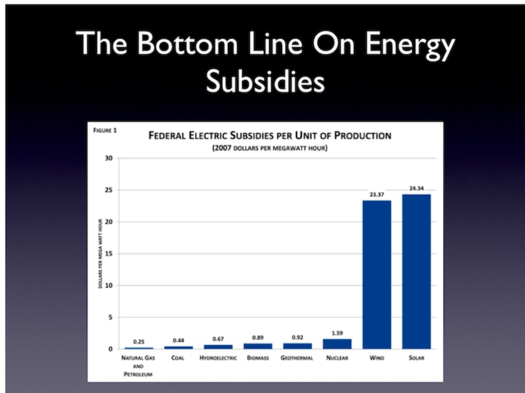
The administration demonizes disfavored American citizens, companies and industries as a tactic to increase its own political power, and slide money to its cronies and supporters. In the long term, this may be the most destructive legacy of the Obama administration.
Environment
The Chevy Volt is apparently going the way of the Dodo. GM has temporarily suspended production of the electric car. No surprises there - electric cars are about as efficient as windmills and the rest of the renewable-energy scam. But if you've not been paying attention to the electric car debacle, you may be surprised to learn that, in the wake of the Volt's utter failure, Ford and Toyota are preparing to reveal their own electric cars.
What explains this madness? Liberal radicalism? Environmental extremism? Democratic sycophancy?
Try sensible profit motive. If that seems ludicrous, consider:
Each Chevy Volt sold thus far may have as much as $250,000 in state and federal dollars in incentives behind it - a total of $3 billion altogether, according to an analysis by James Hohman, assistant director of fiscal policy at the Mackinac Center for Public Policy.
Now, why would two auto manufacturers jump into a market with almost no demand and a high failure rate? Could it be because they're looking for the same kind of subsidies that gives them somewhere around $250,000 per vehicle before the car is ever sold?
The Obama administration has no regard whatsoever for taxpayer hardships or economic sustainability. He is motivated by the purely ideological goals of environmentalism and social democracy - goals which stand in direct opposition to economic recovery and individual rights. Obama is wantonly wasting money on liberal pet-projects in the midst of a debt crisis. He has neither understanding nor concern for the plight of struggling American (would-be) workers and has obviously prioritized his radical green agenda above American prosperity. One hopes that voters will not reward him for this inverted ethic.
Education
I think of all the couples with advanced degrees who have remarkably successful children, and I wonder how other kids can enjoy such success. Charles Murray has long made this a theme of his. The full account can be found in The New Criterion. "Many [in the new elite] have never worked at a job that caused a body part to hurt at the end of the day, never had a conversation with an evangelical Christian, never seen a factory floor, never had a friend who didn't have a college degree, never hunted or fished." Here is the excerpt from today's WSJ:
The members of America's new upper class tend not to watch the same movies and television shows that the rest of America watches, don't go to kinds of restaurants the rest of America frequents, tend to buy different kinds of automobiles, and have passions for being green, maintaining the proper degree of body fat, and supporting gay marriage that most Americans don't share. Their child-raising practices are distinctive, and they typically take care to enroll their children in schools dominated by the offspring of the upper middle class--or, better yet, of the new upper class. They take their vacations in different kinds of places than other Americans go and are often indifferent to the professional sports that are so popular among other Americans. Few have served in the military, and few of their children either.
Worst of all, a growing proportion of the people who run the institutions of our country have never known any other culture. They are the children of upper-middle-class parents, have always lived in upper-middle-class neighborhoods and gone to upper-middle-class schools. Many have never worked at a job that caused a body part to hurt at the end of the day, never had a conversation with an evangelical Christian, never seen a factory floor, never had a friend who didn't have a college degree, never hunted or fished. They are likely to know that Garrison Keillor's monologue on Prairie Home Companion is the source of the phrase "all of the children are above average," but they have never walked on a prairie and never known someone well whose IQ actually was below average.
From the full article, his conclusion:
The upper middle class in general, and the new upper class in particular, will continue to do well. But they will no longer be living any resemblance of what used to be called the American Way of Life. They will be the class on top in the same way that all complex societies have had a class on top, with nothing exceptional about it. We are perilously close to being in that world already....
Economy
Economy
The Czech and Slovak Republics offer an interesting perspective on the European monetary union. Slovakia adopted the euro in 2009, whereas Czech's plans to exchange the Ceska Koruna (Czech Crown) for the euro has been delayed indefinitely. The amicably divorced partners of the former Czechoslovakia thus allow for an interesting comparison.
Slovakia's decision to join the continental currency was deeply lamented when the poorer Slovakia was forced to pay into the Greek bailout fund - a payment for which Czech was not obliged. The Czech prime minister noted: "We can all see how the monetary union is turning into a transfer union or even a debt union."
But this incident simply added insult to injury. The fiscal limitations of a transnational currency have adversely affected Slovakia's economy, whereas the relative flexibility of the crown has allowed Czech to adapt with greater ease and efficiency. This is a condition writ large across Europe. While ostensibly favoring inclusion in the EU, former Warsaw nations regard adoption of the euro as a suicide pact. Writing primarily of Poland's avoidance of the economic pains in Europe, Gordon Fairclough notes in today's WSJ:
Across Central and Eastern Europe, the story is much the same. Governments from Hungary to Bulgaria that once clamored to join the euro club are putting plans on hold and reassessing the costs and benefits of something that used to seem inevitable. The spread of the euro was seen as part of Europe's manifest destiny, and the countries that emerged from behind the Iron Curtain saw the adoption of the currency as a potent sign of success, both political and economic.
The change of heart is an ominous portent for the decades-long process of increasing European economic integration. The common currency is the centerpiece and the leading symbol of that integration. If enthusiasm wanes for the euro, boosters fear, this could spell trouble for other efforts to knit the nations of the Continent together.
Moreover, economies like Poland's and the Czech Republic's are the kind that euro-zone leaders want to bring into their currency union--competitive, with low debt and strong growth prospects.
Czechs believe that a second reason for the diminished economic crisis in central Europe is cultural. Unlike Italians, Greeks and the like, they (and their governments) did not spend lavishly, incur unsustainable debt and expect that rainy days would never arrive. They regard the euro fund as terminally undisciplined and cherish their national economic autonomy.
I have long argued that the New Europe will soon shift the center of gravity away from western powers. But whether this New Europe will remain a union is being decided now by those western powers. Continued fiscal imprudence threatens not only Europe's economic integrity, but its political cohesion.